Episode Transcript
[00:00:00] Speaker A: Hello, dear heart.
[00:00:01] Speaker B: Welcome to the Flourishing Practitioners podcast where we talk all things about space, holding, caring for our clients and succeeding in our businesses. We explore the wisdom from coaches, counsellors and healers.
My name's Gabriel Walker and I'm so
[00:00:17] Speaker A: honored that you're here.
[00:00:19] Speaker B: Let's dive in.
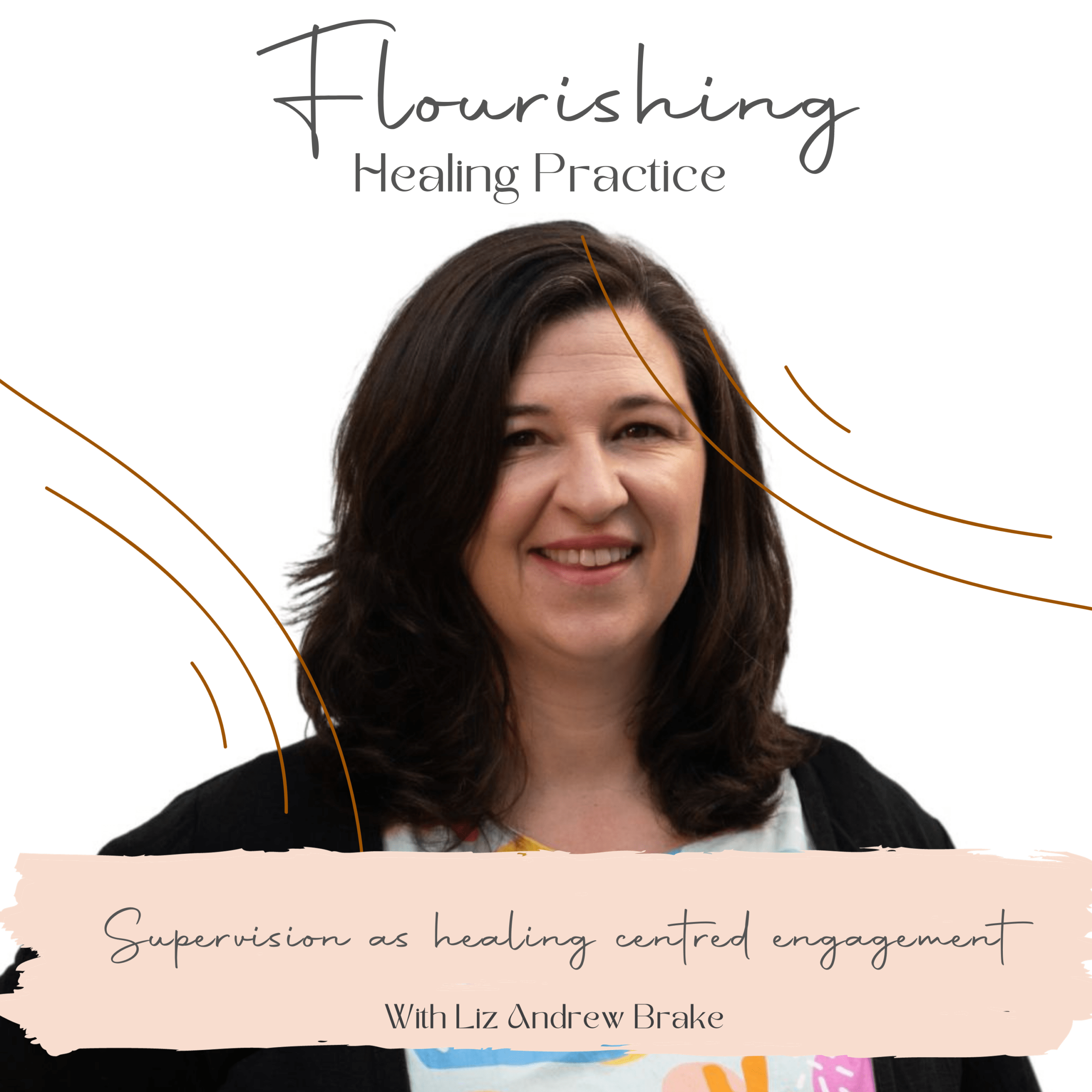
[00:00:20] Speaker C: Hi, beauties. Oh, today we speak with Liz Andrew Brake, who is one of my supervisors.
So a supervision is a practice that in some fields is regulated. You're required to have it if you are holding space and in others isn't. So I sought out supervision with Liz prior to being required to have it as part of my registration. I really knew and felt that I needed someone to talk things over with at times. When we're holding deep space for clients, we have a agreement of confidentiality. I do at least. And the places to process this falls outside our normal friendship groups or our normal aspects of sharing.
[00:01:05] Speaker B: And if you're in private practice or
[00:01:07] Speaker C: working alone or working from home, you may not have this capacity to speak with colleagues as you would if you were in a practice with other practitioners.
Or as Liz alludes to here, if you don't have colleagues you feel safe to speak to. If your workplace environment is insecure or unhealthy, I really advise that healers and counsellors, social workers, anyone who is holding space has access to supervision. Now it's not clarified often I feel about what type of supervision you need. And as with counseling or psychology or healing, every single person has their own style. I personally prefer a more fluid supervision style where I can debrief and process and also explore different ways to see things with regular clients. And at the same time, I also appreciate being able to really just have a safe space to land, to be challenged safely and to be challenged in a way that supports me, my clients. So I finally took around this within our discussion. But I want to emphasize that supervision is a place where you take honestly your insecurities about your practice. You looking, you're holding an energy of wanting to grow. So similar ish to coaching. And you're also being willing to learn from someone who's been there and done that. Often supervisors are people who have been in the field for a while, people who have a breadth of knowledge, maybe across fields or in different experiences. Some people seek out supervision that is specialised in the area they are working in. I personally like seeking supervision outside of
[00:03:02] Speaker B: my field because it helps me to
[00:03:04] Speaker C: expand my ideas and my brain beyond practice norms.
[00:03:09] Speaker B: So welcome everyone. Today I'm talking with Liz Andrew Craig, my supervisor who's also a social worker, supervisor and coach. Liz has been working as a social worker for more than 16 years across Australia, New Zealand and the UK in the child protection sector, in government and non government in a variety of different roles.
And through her own journey of burnout and vicarious trauma, which I'm super interested in, she learned about the importance of supervision and that's inspired her to open up her own business.
And she gets to work with inspiring practitioners like me and now you all as part of their journeys.
She works Ngura. Is that how you say it? Nguru country, Arab people. But she's a PKEH woman, which means non mori, and has lived in Australia for the past 11 years. So there's a few of us Kiwis over here, so welcome. Liz, thank you so much for being here.
[00:04:05] Speaker A: Thank you for having me. I'm really excited.
[00:04:07] Speaker B: What led you to go into social work?
[00:04:11] Speaker A: It's interesting. I've reflected on this a lot over the years.
Went to uni, it was kind of expected of me. I didn't really question whether I would go to uni or not. I just turned up and fell into social work. I just didn't really know what I wanted to do.
Someone had said, oh, try social work. I was doing psychology and it just wasn't really quite fitting with me. It's quite scientific. Even though I quite like science, it just doesn't really speak to me.
[00:04:39] Speaker B: I was a bit bored and I was like, oh, stats.
[00:04:43] Speaker A: Like what stats? There was lots of talk about rats and I was just like, oh, this is just not. I'm just like, oh, this is not for me. So someone was like, oh, try social work. And then like, from my first paper, I just was obsessed and I loved it. So I changed over.
But when think back, like, my mum's a nurse, that kind of caring type professions. And probably for me personally, the type of person I am, it made a lot of sense, but I just fell into it and I went straight from school to uni. So when I was first graduated, I was very young. I don't always recommend that. I don't know if that's the best, but it has meant it's given me lots of amazing experience. I'm very grateful for that.
[00:05:23] Speaker B: I took a different path, but similar in my reaction to psychology, I changed to community development because I was like, what?
I ended up doing a minor in social psychology, which focuses more on the community aspect of psychology. I found that interesting. But, yeah, the rats and the dead white guys.
[00:05:43] Speaker A: I just was like, how long does it apply to what I might want to do in the future? I just couldn't see how it was interesting, but no.
[00:05:52] Speaker B: What was your burnout journey? What led you there? How did that come about?
[00:05:57] Speaker A: It's a long journey. I was really young when I first fell into social work and I went straight working in child protection. I worked in South Auckland, which is quite a low socioeconomic area. It was quite confronting. I guess when you become a social worker or whatever profession where you're helping people, you're often not really prepared for how to manage that. So I kind of just pushed through. I moved countries. I've worked in lots of different areas.
I think when I look back, I was suffering various forms of burnout and vicarious trauma, but just didn't even realize it, didn't even realize what it was. And it just wasn't really talked about. And you just push it down and keep on going. That's just the nature of the work. And then I became a manager in Australia, actually, and I just wasn't really enjoying it anymore. And I ended up applying for a job that was as a practice lead. So it wasn't frontline. I wasn't working with clients anymore. And it actually gave me an opportunity to stand back because there wasn't this crisis or adrenaline. And it was really hard. It took me about 12 months, I think, to adjust to this different pace. And I realized that I was really addicted to adrenaline. It was just part of who I was, especially because I was so young. When I started in my early 20s, it was almost an addiction. It was really uncomfortable to come out of that.
I was really quite depressed and anxious and I just. I realized that I was burnt out and that also that I had vicarious trauma. So elements of my worldview had changed from working in the sector.
When I started realizing this, I was like, oh, this is why I'm feeling like that. Once I was away from that, I almost needed to step away from it to totally realize it.
And I started delving into doing a lot of self reflection. I'm quite a reflective person. I started realizing that.
[00:07:43] Speaker C: Oh,
[00:07:46] Speaker B: supervision.
[00:07:46] Speaker A: I hadn't had a lot of really good supervision throughout my career. And then when I landed in roles where I was required to provide supervision, but I was their manager. I don't know if I was the best supervisor at that time because it wasn't.
[00:08:01] Speaker B: Yeah, it's tied to outcomes rather than their wellbeing per se.
[00:08:04] Speaker A: Exactly. People get promoted because they're good at what they do, but they don't necessarily get Taught the skills to be that next person. So I never really got taught how to be a supervisor. And also it's a really busy role.
[00:08:15] Speaker B: Your skill set until that point was like, go, go, go, go on adrenaline. Which actually isn't what you're wanting to impart.
[00:08:21] Speaker A: I look back at some of that thinking, oh God, you kind of cringe as you do sometimes when you look back on things. But it was all learning. I just realized it just took me on a journey of learning more about supervision. What was good supervision, what's important.
That really helped me.
[00:08:35] Speaker B: How would you view or consider supervision as a practice?
[00:08:39] Speaker A: There's so many layers to it, but I guess on a kind of. It's really. It's a joint relationship. So it's a joint endeavor to have supervision. It has to be with a supervisee and a supervisor.
So it's about the practitioner, if I would use the word practitioner or supervisee, that they are given an opportunity and a space to talk about clients, to think about their own relationship in relation to the client. So thinking about their bias and judgment, the how their previous experiences might influence that relationship or the way that they work with that client, it's building on their development.
There's so many layers to it. The tricky thing is people get confused about what's the difference between counseling and supervision. And supervision is really work related.
So you might bring in personal things. Cause obviously that's possible. You might say, look, this is impacting my relationship with this particular client because she reminds me of my mother or something. So you talk about that.
But it is quite separate from say something like counselling. And the whole idea of supervision, I should say as well, is that ultimately it's about the practitioner or the supervisee being able to be the best that they can to work with clients and also developing their skillset and wellbeing.
[00:09:59] Speaker B: I always think of it as the supervision practice is about our clients, it's supporting our clients. And so sometimes to be the best practitioner, we have to sort through some personal shit too. Like the trigger that we're receiving from a client or that whatever dilemma, processual dilemma that we're having could be our own shit.
So we need to take it to counseling. But sometimes it is the moment to process a little bit in supervision, but with a professional lens.
[00:10:26] Speaker A: Yeah. And thinking about how it's impacting on those particular things as well.
[00:10:32] Speaker B: Can you define vicarious trauma for those of us who don't know what it is? It's a really important concept.
[00:10:38] Speaker A: I think burnout, vicarious trauma and Compassion fatigue. We use them interchangeably, but they are quite different.
So burnout can happen to anyone. A lack of support and lack of resources. So anyone can get burnout. Vicarious trauma is when you're exposed to other people's trauma.
So it happens when you listen to. When you're exposed to and listen to other people's story of their trauma.
The symptoms of vicarious trauma are very similar to trauma symptoms. They play out in us the same way.
And maybe you can get it even just from reading so roles or people that might read a lot of traumatic material that can create it, or face to face. You're a counselor or whatever that might be.
I could go on and on about vicarious trauma and trauma. The symptoms are pretty much the same. And so vicarious trauma can actually shift your world view. So it makes you see things through a different lens because of what you get exposed to. An example that I always use is something that really struck me, is that when I worked in child protection, I was working with a lot of families where things weren't going well and maybe relationships weren't great and things like that. And so when I used to see a nice family interaction on the street, it would really, like, hit me in the feels and it would so heartwarming. Like it was this really unusual thing. And so my brain kind of got warped into thinking that that was unusual because I was so exposed to, through my role of certain types of families that were entering the child protection system. So that's an example. But there's loads of different examples where your worldview might change.
And compassion fatigue is where you're in caring roles. So that can be through our kind of roles like counselling, social work. But also that can come about from nursing, if you're caring for, say, elderly parents or disabled family members, things like that. So it's basically, you've got a lot of caring responsibilities.
And so over time, your compassion wanes and it has a massive impact on you. That's something really for people to be aware of, because often in our lives, not only we've got our work that we're doing, but then often we're caring for children, parents, siblings.
[00:12:51] Speaker B: I experienced that recently where I was like, I think I've got compassion fatigue because people, friends or family would be telling me things, and I was almost numb. Like, I couldn't.
I knew there was a human response and I cared, but I couldn't care.
[00:13:05] Speaker A: You don't have the energy.
[00:13:06] Speaker B: And then it was like, okay, back out of this. You've got to Create something different in your world.
Would you say that's a really common element that does bring people to supervision?
[00:13:17] Speaker A: It definitely is. Also Just to mention that vicarious trauma in particular, it's inevitable in the work that we do. So everyone will experience vicarious trauma. If you're working with people that have experienced trauma, you will experience it in some degree. But what you want to make sure is if you think about it, I often think about it on a continuum, is that you catch it early on and that you put things in place to support yourself rather than letting it get really bad. You hear of really tragic stories of people, say police or something getting PTSD and things. And so you really want to catch it early because it's a lot easier to do things about it early on. Not to say that you can't do something if it's way down the other end of the continuum, but it's just a lot easier to catch. And so I'd say most people come to see me when they're noticing that they've got burnout or vicarious trauma. That's a really common thing.
Also interestingly, toxic workplace, this is a really common one as well. People trying to manage that. And I think that also brings in elements of that.
[00:14:19] Speaker B: When I did my supervisor training, I noticed that workplace thing. I was like, oh, this is systematic. I just felt really heavy. I was like, ugh. I don't know. Is supervision required in the social work space or is it not optional?
[00:14:31] Speaker A: So in Australia, the social work profession doesn't have to be. It's not registered.
So theoretically, anyone can call themselves a social worker. I'm registered with the Australian association of Social Workers. So if you are registered with them, then yes, you have to prove in order to get your registration yearly you have to do 10 hours of supervision. And they've recently changed their practice standards, so you actually have to have it with a social worker.
[00:14:58] Speaker B: I think I sought you out before I had finished my counselling training because I was feeling very isolated. So it was like the opposite of, of being in a workplace and just going, okay, this, you can't. You're not allowed to talk about your clients things, but you're trying to process that on your own that often not an ethical dilemma. It's like there's all this information and I'm trying to move it through my system, which maybe has no idea about the circumstance. I'm getting pockets of hours of information all downloaded into me and I'm trying to process through like the best course of action.
[00:15:32] Speaker A: Sometimes things you do need to talk about. I usually start supervision by saying, oh, is there anything that you want to talk about or what you want to get out of today? And lots of people are like, I just want to talk about this. I don't need you to do anything. I just need someone to talk through with.
[00:15:45] Speaker B: I'm like, okay, yeah, I really appreciate that about you. I've had other supervisors when I was first looking for supervisors and they were like, right, here's our schedule. What if something else happens? That's not what I need. And how would you describe yourself as a supervisor?
[00:15:59] Speaker A: I am very flexible. I mean, what we were just saying, like I really want to mold supervision to what's going to meet people's needs.
I think this is not one size fits all. I'm not an agenda type person. That's not me. In fact, I had someone the other day, we had a first session and I said, oh, do you set an agenda? And I said, well look, if you want an agenda, I'm happy to do that. And she said, no, I don't want it. I said, okay. I like the relationship, to develop a really strong relationship to get to know each other and then just see how that develops and some threads of conversation.
I'm quite flexible, but I also like to have a laugh. You'll probably find me maybe talk about the patriarchy or something like that in the middle of a session because I can't help myself. But I've got to bring some of that social work.
[00:16:45] Speaker B: I really value that counted off with our last session. On the session before where it was, you were like, right, well, we can look at this at like the individual, the client, the community and the society. And there's something in my body that's just like, oh.
Because it sorts it out. Instead of this like right and wrong, there's processual accountability and task orientated accountability. And I'm definitely a processual accountability.
Yeah, I like touch bases and I like people to ask me about what I'm doing. But if you say you have to do it by this date or did you do that thing, like it just raises it. It doesn't feel good for me.
[00:17:23] Speaker A: I've developed it a bit over the years now. And that having that first conversation or that first session is really kind of asking people what kind of how they like to work. Because I have found that some people do want to be asked. They want a little bit of homework, not a load. But they might say something like, can you ask me next time? It holds me accountable, which I'm fine with. And I just write a little note, ask about this.
But as a general rule, most people don't. They just want it to flow and evolve.
[00:17:51] Speaker B: I know that you work across fields because you work with me.
Do you see any difference across say like social work supervision or counseling supervision or is it fairly.
[00:18:01] Speaker A: No, I mean I actually work with quite a few lawyers as well.
Yeah. Loads of different professions actually. So to be honest, no. Like the type of work that they do is different, but the dilemmas and the things that they're wanting to process are fairly similar across the board.
And as I've said, there's quite a lot of people that are navigating challenging workplaces as well. So we might never even talk about a client in a session. But helping someone navigate a workplace ultimately helps them free up capacity to then be able to work with their client.
[00:18:37] Speaker B: That's something I know very little about because haven't worked for a while. What would you say to someone that is struggling in their workplace or with hierarchy or.
[00:18:46] Speaker A: I noticed that people are talking about challenging workplaces.
People are really stuck in this triangle. So it's. There's always a victim, a perpetrator and a savior, I guess. So people get caught up in this dynamic and so it's really important just to help people get off the triangle and not accidentally fall into these roles.
And I think that there's a number of reasons for that. Like systemically the sector is really challenging and people are struggling. So the people that we're working with issues are more complex. People are more traumatized and that just ends up playing out. A lot of those dynamics end up playing out in workplaces in a way.
[00:19:28] Speaker B: I also get asked often and I wonder for myself how you get off. I call it the victim triangle. I know technical turbulence probably because victim's my go to triangle to the impound triangle.
[00:19:41] Speaker A: I think that's really interesting because it can be quite individual. I think the first step is recognizing it.
So often for me, I will just say to someone, have you heard about this triangle? This is really interesting. And help them see some of that dynamic and maybe they are putting themselves or putting their boss or something in a particular role. And then it's feeding in so doing so just pointing it out. I think that's the first step then to get off the triangle.
There's a whole bunch of ways, but I think one of them is just viewing your role in a different way.
So it's just not feeding into that dynamic.
[00:20:18] Speaker B: Because I'm an energy worker, my speak energy is my language. But I always think of it as an energetic thing. Once you're aware, you can go, oh, my energy's in victim or perpetrator or whatever. And I'm bouncing around. So what does that energy feel like in the empowerment and gradually move myself via energetic. I don't know how long I've been receiving supervision, but initially I was like, okay, so I'm feeling really alone. And supervision seems to be a thing, but it took me years to actually figure out how to use it well. Like, I don't. I think I was showing up and being like, I'm a good girl.
[00:20:52] Speaker A: Like, yeah, I'm doing what I'm supposed to.
[00:20:55] Speaker B: Yeah, look, here is how I'm not, like, breaking any of the rules.
[00:20:58] Speaker A: So you were like, presenting.
[00:21:00] Speaker B: Yeah, yeah, I think I was. I missed out probably on a lot of opportunity for growth because of that. And what would you say to someone who's maybe in that or stepping in? There isn't much explanation about it given as a blanket thing. Oh, you're burnt out. Like, supervision might help. I see it all the time on different Facebook groups. If someone has a dilemma, everyone's like, seek supervision.
[00:21:19] Speaker A: I haven't really given that a lot of thought that people might be coming and saying something, you know, differently, because it is a scary thing. You're sitting in front of someone, you're one on one. It's a professional. Honestly, I'd say allow time to develop a relationship because some of the tricky things is people might come once or twice and then, oh, maybe it's not giving me what I need sometimes. The beauty of it is developing that relationship so that you can trust someone or talk about it as well from a supervisory perspective. I'm really passionate about being vulnerable myself.
So I think it's really important for people. I'll say leaders, I don't know if that's the right word, but people in those kind of roles to show vulnerability themselves, to make it okay for other people, because that's a critical component of our work. We really have to be vulnerable in order to evolve and change and be reflective.
[00:22:13] Speaker B: For me, it was doing the supervisory training that made me go, oh, this is actually what supervision is. The people that were doing the training with me were older and we had to do a lot of role plays and they were just so vulnerable. I think I had a lot of fear. You know, you go through your training and there's all this, like, fear based training. Like, oh, well, if this happens, then that there's not the teaching you how to actually seek good supervision, which I think is a make or break of you. Not in every instance, but it's pretty important.
And you're not taught how to use that resource. There was something in watching individual supervisions and seeing where it could go that really expanded me.
Even though I do not work in black and white in my practice with my clients, I think I saw the supervisory practice as more of a gatekeeper than a support system.
[00:23:05] Speaker A: Yeah, maybe this, like, oh, I'm sitting in front of someone that might be really good at what they do. I don't know. There's an element of kind of. It's a bit intimidating. Yeah. No, I would say to people if they feel like maybe, oh, I think I need supervision, but you don't know why, or go find a supervisor and say, look, I don't know. Can you tell me?
Can you help guide me? Because lots of people do that too. I have lots of people that come and say, look, I've never had supervision before. I don't really know what to expect.
So then we just talk through what are their career goals, what are the things that they're struggling with, what are the things that are going really well? And then it just evolves from there.
So. But I would definitely say don't be afraid to be vulnerable. I mean, you know, supervisors shouldn't be judgmental. I mean, I've heard it all. I've heard so much. These are things that we're challenged with. And the fact that people are showing up to supervision shows me the type of person that they are, that they're wanting to evolve and be the best they can for their clients, too.
[00:24:04] Speaker C: I love that.
[00:24:05] Speaker B: Is there any other aspect of supervision that I haven't asked on that you're thinking about?
[00:24:11] Speaker A: But I think it's really interesting to think about.
This doesn't apply to you in your own kind of practice. But I think people that might be working in areas where they receive supervision in a workplace is a really interesting thing.
And I really would encourage people to seek external supervision as well. And I'm noticing it more and more with workplaces, which is good, because I really don't see think that workplaces or managers in the workplace, through no fault of their own, are able to give a balanced supervision. Some theorists talk about four functions of supervision, and I don't think that people in the workplace can provide all of those functions. It's quite limited. So sometimes you might have to seek external.
[00:25:00] Speaker B: Do you want to tell the functions
[00:25:02] Speaker A: now you're testing me, Gabriel, about what all the functions are okay, so there's four functions. So administrative is making sure that people with ethics and policies and procedures. If you work in a workplace, are you doing notes and those kind of things. Those things that we sometimes aren't so good at doing. And supportive obviously speaks for itself around supporting the practitioner and the same with education. So that's about educating and developing the person. And then mediation is like being a bridge between. So if you're in the workplace that's like a bridge between getting your view up to management or vice versa. So the mediation component and then an external supervision ICS is like connecting people to more to do with the sector, what's happening in the sector or say if you're a social worker then what's happening with aasw, that kind of stuff. I find it quite useful the four functions to think about. It just provides a bit of a framework.
[00:25:55] Speaker B: Sometimes you enjoy promoting and supporting people having a long lasting careers in the industry and I would say it's a high turn rate. I don't exactly know what my question is, but do you have anything to say on that?
[00:26:09] Speaker A: I say the sector and I'm talking about anyone that's working in a helping profession. It's really not easy and people do get burnt out, they don't know what to do and they end up leaving. And it makes me so sad because even if I say you work in a particular role, if you're not enjoying it, there's. So if you work in helping professionals, there's so many different things you can do and skills are so transferable. So I really love helping people see their potential and develop their skills and move almost sidestep to a different role or even going into private practice and still helping people but in a different way.
I think people sometimes feel stuck. I see this with child protection workers that work in the statutory child protection and they just feel stuck there. But what they don't know and that might be that's a really challenging role and there's loads of systemic issues and they've got so many transferable skills and so what I'd hate for them is just to leave the sector entirely and that maybe they can become a counsellor or work with disability. It is so many things that they could take those skills and use them. So that's what I'm really passionate about.
[00:27:18] Speaker B: Yeah, I agree. Say. Cause I know when I reach that burnout. I don't know. I've been trying to find a different word for burnout because. Cause recently when I got that compassion fatigue Thing I think my soul was burnt up and my energy and body wasn't. There was something out of balance.
[00:27:32] Speaker A: Have you heard of like. Cause I was gonna say it before, but there's this moral distress and moral apathy. It really speaks to me because it's basically where morally it's more to do with the system you're working in systems that morally you don't agree with, but you're restricted to work with them.
Moral distress.
[00:27:52] Speaker B: Well, you've heard my blahs about this. But also when I've been going through my counseling training, I found it very challenging because I do know that the other roles that I'm carrying provide a lot of liberation and freedom just to open those little ways of thinking different for people.
But I don't believe in that. Our role as a counsellor is to get people back to the status quo. A lot of counseling work, sometimes in the training is about regulation.
So like sometimes we need a break to break down to. To get to the new. Rather than regulating, regulating, regulating. I'll just go, I'll just keep going to work. I've got to push through because that is like, sometimes that's not the answer for me. It's about finding out individual circumstances and answers and movements and what's happening and the world's changed so much.
The answers that were provided even two years ago. Announcers that as a general cohort that would support. I found that.
I don't know if it's moral apathy would be the words I'd use, but I'm relating to the definition of it in terms of being Mori in Australia. So we're carrying some of our energetic DNA imprints of trauma here, but we're not in the same cultural system, but we're trying to enact the same cultural system.
So I often feel torn because I'm meeting people where they are, but I'm getting draw. I'm talking energetically, but I'm getting drawn into different energetic frequencies of where people are at and their cultural identity constantly, which sometimes depending on when they came to Australia, they're assuming that that's what it is to be Mori. The Mori landscape has changed so much in New Zealand. We're almost a different collective, or what do they call it? Diaspora. There's like an academic term when you oh my God, I'm going to look it up. Sorry, it's going to bug me. They're living outside the traditional homeland sociological brain.
We actually are forming a different.
[00:29:45] Speaker A: Your own identity.
[00:29:47] Speaker B: Identity as the space holder for that. Sometimes having to Meet the person in a place that their diasporic identity, their Australian identity has formed without any context of what I know. And then the marijuana identity battling with the Western identity. I'm quite often in a systematic battle inside of my own body. Yeah. Which is exhausting. I don't want to do it anymore, but I know how to.
[00:30:19] Speaker A: I was actually doing a presentation yesterday on a healing centered engagement. It's acknowledging that trauma informed practice is great, but it's not enough and it's missing stuff. The term was coined by someone and then America, an African American man. He's an activist and a researcher. Dawn Gin Wright is a name. It's nothing new, particularly to indigenous peoples. You know, it's a term that's really taking traction, I've noticed. And basically it's identifying that we need not just to be have trauma informed practice, but we need to take it to the next step and we need to move into this healing space. And so it's identifying that a lot of supporting people who have experienced trauma to be take it be political and not clinical.
So that's about supporting people to be empowered and influence change.
So when we help people to then have their own collective action and take things into their own hands, actually that's really healing to the individual as well as for society. Because what happens, say for example, like lots of this moral distress and say if you work with lots of people that have experienced domestic and family violence, say you might help that individual, but then you keep on saying the same situation over and over. And that's where that moral distress and moral apathy comes in because the system's not changing. And so this healing centered practice is really interesting. It takes it to the next step. So it's what we need to change the systems, but also you need to help the people that we work with to change the system. It's not necessarily up. It is up to us as practitioners, but it's also up to people with lived experience. I just think it's really beautiful. And one of the concepts is around culture and identity. So supporting people to really connect with their culture and identity.
And that's really critical for healing. And sometimes we kind of miss that a bit with trauma informed.
[00:32:15] Speaker B: Like honestly doing akotorupano and teaching Mori healing training, I would say that is the thing that brings most people to the training they do. They have, they're already healers like they already know. Once you unlock them, they're already doing it in their community or whatever. But the actual Mori healing that happens by learning Mori healing Within yourself because of the alienation from our own culture being over here for whatever reason people came over and then the trying to fit into boxes in different ways that you don't ever really fit into.
[00:32:49] Speaker A: It's like essential and then maybe even got. When you go back to New Zealand, it has changed so that you feel a bit like, you know.
And one of the things that's interesting because that's obviously the healers.
Healers themselves. And so one of the components of this healing centered engagement as well is about practitioners themselves and how we need to go on our own healing journey. And basically saying that trauma informed practice doesn't really identify that and that we need to have our own collective action. We need to connect to culture and identity and also like identity in the sense of other groups, whatever that might be. Where's our sense of belonging takes all those concepts and things like that practitioners or are working in the field that we should need to do that ourselves. And then the very nature of the fact that we're working with people that have been traumatized is that we need to ourselves be on a healing journey all the time too.
[00:33:40] Speaker B: Yeah, I love that I was thinking about this last night after a client that the thing I loved about studying counseling was the real emphasis on person informed. The person always has their answer and they give you the answers and you move at their pace.
Which sometimes I don't know if it's always helpful. If someone's received, say a lot of counseling or a lot of healing and they're glooping.
[00:34:05] Speaker A: Yeah, they're stuck in it. And that's.
[00:34:07] Speaker B: How do we move from being person informed but not also reintroducing trauma by forcing them in a new direction. Even if it's like a helpful one to move someone from their own will, but not from their like, but from their loop.
That what I consider healing is like just opening different doorways for different pathways that you. And with something that I think that we're doing in this space, I'll call us healing practitioners, social workers, counselors, psychologists,
[00:34:35] Speaker A: all of that all encompassing. I always struggle to know what to say professions I don't know because I
[00:34:42] Speaker B: don't like the word helper either. Yeah, like how we hold that in. In an empowered way.
[00:34:48] Speaker A: He like and this is this whole concept as well saying we don't forget about trauma informed practice. They're not opposites. It's just building on trauma informed practice. But he's saying that what happens over time is that trauma, as much as we don't intend to it we end up, when we talk about trauma, we end up maybe being deficit based because we're always keeping people or talking about trauma, which isn't always helpful. Like we want to acknowledge it, but then as you said, we don't want to end up in this loop. And so Hugh will do it all the time. Is that changing our language?
Is that healing? It's a positive word. I really like when I was doing some research where I was saying 30 years ago, before trauma informed practice, the question would be what is wrong with you? And then with healing centered practice, the question is what is right with you? So it's building on strengths. Isn't that beautiful about like language is so important, like aboriginal friends and things about the word healing. And even for some people, the word healing doesn't sit right, particularly in the first nations communities, because some people see it as implying that you have to get over something and that there's this end phase that you have to get to, whereas people shouldn't have to get over really horrible circumstances that have been done to them.
[00:36:08] Speaker B: You know, I so agree. I just got sick of reframing words. Once someone would point out where it went. Like when I developed a group, I went off empowerment for a while because that they had talked about how like there was a period where all the
[00:36:21] Speaker A: government strategies had empowering empowerment, child protection, resilience.
[00:36:25] Speaker C: Resilience.
[00:36:26] Speaker B: The word empowerment.
I know, I just, I just never.
[00:36:31] Speaker A: That never occurred to me. To me it's a really beautiful word. So I think it also goes back on our relationships as we develop. Working with people about checking in with them works for the individual.
[00:36:41] Speaker B: Yeah. And so when a person is realizing that they're having anything happen to them, like a practitioner, if they're realizing, okay, like I'm nearing, we'll say burnout, but for whatever reason or whatever underlying thing.
[00:36:58] Speaker A: Yeah.
[00:36:59] Speaker B: What does self care look like?
[00:37:00] Speaker A: It's a buzzword.
[00:37:01] Speaker B: How's your self care? I still get tired and exhausted and stressed and burnt out.
[00:37:07] Speaker A: Well, and I think there's a thing. It's going to be inevitable, you know what I mean? Unless you live in a silo or you don't work, you don't have family stresses or personal stresses. So it's about, it's. I think the first step is really recognizing it and understanding it. But I probably piss people off all the time because I think some people come to me and want some kind of magic wand.
And the thing is, is that it's so individual. So it's individual for ourselves, but also the symptom that we are experiencing. Experiencing is individual. It needs an individual response.
Say, oh, go and go for a run or you know what I mean, go do some exercise. Well, if you're really heightened and really anxious, that might not be getting your heart rate up really high, might not actually be the best response. And maybe even your. You personally, that doesn't do anything for you. So often the session of trying to unpack. Okay, well what works for you, what doesn't work for you? What's your symptom?
Cause more so if you're thinking about, if you're really dissociating, like you're feeling really numb, feeling that apathy or whatever, then going and listening to some really depressing music or might not be the best thing, you might need to talk to someone. So that's something I'm quite passionate about, about really trying to think about what's the symptom. Like burnout happens or vicarious trauma happens for a reason. Even sometimes working in the same place, you might not actually be able to move past it because it's the workplace or whatever it is that's creating it. So that really annoying because then people are like, what can't you know, people just end up with this list of self care things. And then when you don't do it, you feel bad.
[00:38:48] Speaker B: You've just got added more things to your to do list, which is probably part of why you're already stressed. I heard a really beautiful thing which helps me at least consider where I'm at. I don't know if this is the terms I love exactly, but it's like the difference between masculine and feminine needs.
Yeah, like the feminine wants to be out and about to move, to flow, to dance, to go to yoga. And then the masculine wants to isolate and like watch TV and Netflix or read a book. That sort of allowed me to give myself permission because I used to force myself if I felt down to go out.
Maybe I've had like too much like, okay, it's not social connection, but too much human humanity.
Yeah, too much humanity sounds funny. But yeah, I like that idea as well as a starting point to figure out for myself.
[00:39:35] Speaker A: A lot of people that come to see me are not really in tune with their emotions because I think sometimes the work and also it's what we've learned as well. But I think the work, sometimes people push it down and so they're not even quite sure where they are. And so getting people to stop and think and tune into yourself, you ask yourself right now, what do you need.
And even after you've had whatever it might be, a session or a phone call or something with the client just stopping for a few seconds. And it doesn't have to be a 30 minute thing, but just like, okay, how did that sit with me? How am I feeling? Just acknowledge it. I just think that's really important. I think we're kind of.
[00:40:11] Speaker C: Yeah.
[00:40:12] Speaker A: It's being taught that we shouldn't be doing that.
[00:40:17] Speaker B: Yeah. Thank you so much.
I really appreciate how you roll me and the wedding yacht as well. Allowing you to shop, however, whatever. And all my personalities and roles.
[00:40:29] Speaker A: It's been so much. Thank you.